· 7 min read
Non-Stop Travel
For 45 years, I worked in the advertising business. In 1980, I began my second major account assignment at LINTAS on the Los Angeles, California-based Carnation Pet Food advertising account. It was an important and high profile piece of new business that agency management fought hard to win. SSC&B had promised the Carnation executives that they would be getting all of the resources, experience and creative fire power of a top tier New York ad agency, and that is what Carnation wanted.
But it wasn't enough. The client said that their brand teams were accustomed to working with an agency that was just ten minutes down Wilshire Boulevard, an agency that could drop what they're doing and run right over for a meeting, an agency that would spend time outside of the office getting to know their people. That kind of "personal touch" was important to them. They challenged us to make it work. Whatever it took, we promised that we would deliver. SSC&B promised that we would service their business as if we were just down the street. No matter what.
What I learned was that if you do something often enough, you find that you can do almost anything. The impossible soon becomes routine.
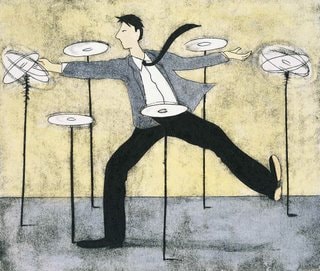
And so, for the next three-plus years, I spent three days a week in Los Angeles, every week, 50 weeks a year. That left about one and a half days in the New York office each week. It was an absolutely insane schedule. I constantly felt like the juggler on the Ed Sullivan Show (remember the Ed Sullivan Show?) who was spinning six plates on six different sticks. I kept the plates spinning while trying to keep the clients happy and trying also to have a personal life.
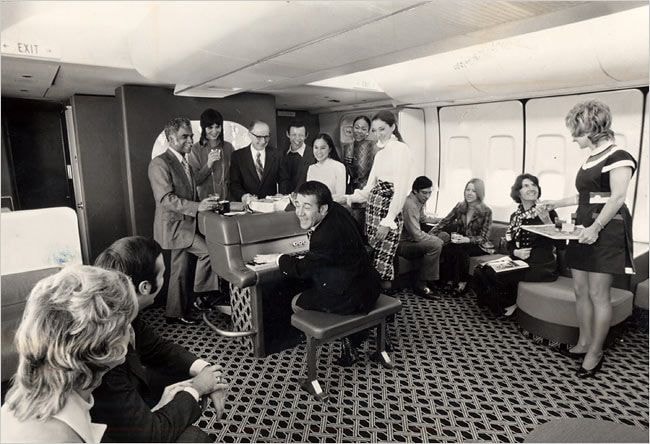
One of the first – and biggest – routines was the plane flights. American Airlines had an early afternoon non-stop 747 jumbo jet flight that arrived at LAX by late afternoon, giving you plenty of time to pick up your car, get to your hotel, check in, and relax before dinner. (This was in the early 1980s, when – if you were fast on your feet – you could arrive at the airport 15-20 minutes before your flight and still make the plane.) And with a few rare exceptions, I took the same flight every week for three years. I quickly graduated to American's top frequent flyer status and flew first class every time.
Invariably, one of the other first class passengers – one of the white passengers – would try as politely as possible to point out to me that I had inadvertently sat down in first class and that the coach seats were further back. Or they would ask, "What's your seat number?" Occasionally, if the mood struck me, the person sitting next to me would awkwardly attempt to ask if I was in the correct seat, and I would turn to them and announce that this was going to be my Rosa Parks moment. I was fed up and I refused to move to the back of the plane.
Totally aghast, my seatmate would press the call button, summoning the flight attendant. But when the flight attendant arrived, what my seatmate heard was the warm, familiar greeting of, "Good afternoon, Mr. Robinson. Can I bring you some champagne?" The flight crew – who were always the same because I always took the same flight – were like my extended family. I knew them as well as my own agency staff.
And when the time finally came, after three-plus years on the Carnation account, I told them that next week would be my final flight. The flight crew found a way to close off the upper deck of the 747 and throw a private party for me with dancing and non-stop champagne. Even the captain joined in. We hugged. Some of us cried. And we promised to stay in touch. We were still saying long goodbyes after the plane had landed at JFK. Passengers exiting the plane craned their necks attempting to look up the spiral staircase to see what was all the commotion upstairs.
The hotel was another steady routine, but we wound up shifting to new hotel routines a few times during my tenure. Our first steady hotel was the Beverly Hilton, a major Beverly Hills landmark at the intersection of Wilshire and Santa Monica Boulevards and site of a few different award shows and the Academy's Governor's Ball. We stayed at the Beverly Hilton for probably nine months.
But then one night while we were having drinks in the hotel bar a very, very intoxicated Ian McGregor loudly proclaimed, "Wait a minute. Wait. Do you mean to tell me there are hookers in this bar? Real hookers? Where? Point them out. Show me the hookers." To the four of us who were sitting and drinking with Ian, this was absolutely hysterical. Ian was our new boss making his first trip to the coast and his barely understandable accent was one-third thick Scottish Highland, one-third Rhodesian, and one-third Johnnie Walker. Unfortunately, however, for the rest of the bar, this did not go over well. Nothing was said. There was never a fuss. But suddenly our agency travel department was unable to make any reservations for the following week. We found a new hotel.
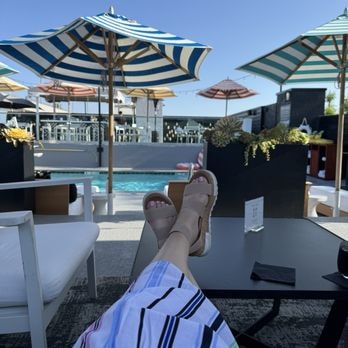
Our next hotel was Le Parc, a small boutique, all-suite hotel tucked away on a quiet residential street in West Hollywood. Now that we knew our way around town and LA was our "home away from home", Le Parc was much better suited to our needs and our lifestyle. While the Beverly Hilton was a gigantic palace that attracted both tourists and Hollywood industry types, Le Parc was tiny by comparison and did not attract any of the "see or be seen" crowd. However, the hotel was a favorite among a number of rock musicians and bands. If you were having lunch in the hotel's only restaurant, you were likely to see Billy Joel having breakfast. Or you might run into Duran Duran by the rooftop swimming pool.
One day as I was exiting the hotel parking garage in my rental car, another vehicle was arriving and attempting to enter. If we had both been driving Hondas we might have been able to navigate the hotel's narrow driveway without colliding into each other. (Of course, if we had both been driving Hondas, we would not have been in West Hollywood.) But I was driving a big convertible and the other car was a stretch limousine. Oddly enough, I did more damage to the limo than he did to me. As the limo driver and I began exchanging information, about a half dozen passengers started popping out of the back of the limo. It was the Australian rock band, Men At Work. They were incredibly good natured and offered to have drinks together later that evening. They shrugged off the car's damage by saying, "We wouldn't be much of a rock band if we brought back the limo in the same condition we got it, would we?" I made new friends.
Ten years later, I was now working at a different ad agency (UniWorld) and working with a different client, Coors Brewing Company. The VP of Marketing at Coors had challenged the agency to develop a marketing campaign that could succeed even if we were outspent two-to-one by Budweiser. We created a campaign called The Coors Lightshow. The concept of the Lightshow was to share experiences with our target consumers the way friends share good times with each other. If we include these consumers in our good times, they will include Coors Light in their good times.
A "Lightshow" became any experience Coors Light created to share with its friends; a party, a TV show, a basketball game, a comedy show, great music. As we said before, the what didn't matter half as much as how we were doing it. So, we did crazy, different things all across the country. UniWorld was betting its credibility and relationship with Coors on the success of this program. If we succeeded, the rewards would be huge; but if we failed, we would almost certainly lose the business, one of our biggest clients.

I assembled a road crew of about a dozen people to cover all of the operational, logistical and creative needs of the tour. We were a traveling circus. We created a schedule that put us on the road for 3-4 weeks at a time before returning home to rest, regroup, and plan the next burst. We did this for nearly two and a half years.
In many respects, the traveling regimen was similar to my years shuttling back and forth to Los Angeles on the Carnation account. But ten years had passed since then. The big difference was that I was single then. Now, I was married with two children in elementary school. Now, I was missing a lot of school concerts, parent-teacher conferences, and T-ball games. The absences were difficult on all of us. I was also ten years older, and all this traveling stuff wasn't fun anymore, especially since most workdays did not end until around 3AM. I spent a good deal of the time in a bad mood, which actually had the unexpected benefit of discouraging the crew from too much goofing off. Thanks to my bad mood, we were able to maintain a highly efficient and effective operation throughout.
At the end of the first quarter that the program was in place, we were able to track an increase in Coors Light sales. In a product category that had not seen an increase in sales of more than +2% in over a decade, we grew Coors Light sales by +7%. By the end of the second quarter of the program, sales in the Lightshow tour markets had increased +11% versus the prior year. In the two and a half years of the program, we kept this pace going, until finally, I could no longer keep the travel pace going.